
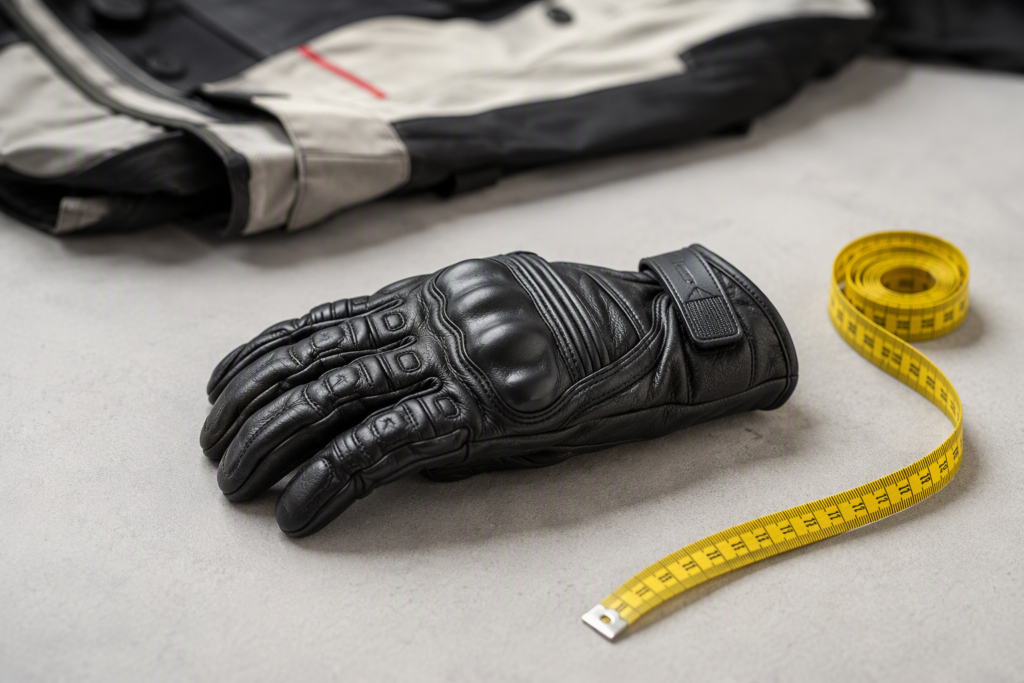
Motorcycle gear sizing for wholesale buyers starts with Asian-fit measurement charts: for Southeast Asian markets, order gloves in S–L (roughly 40% M, 35% L, 15% S, 10% XL) and jackets in S–XL, and always request physical samples before bulk production. This motorcycle gear sizing guide breaks down glove, jacket, and riding suit measurements so distributors can stock the right mix the first time — and avoid costly size-return cycles.
Size mismatch is one of the most common reasons wholesale motorcycle gear ends up discounted or returned. The problem is rarely the product quality; it is usually a mismatch between European/American size charts and the actual body measurements of local riders. A distributor who understands how sizing works across product categories — and how Asian fit differs from Western fit — can turn inventory planning into a measurable advantage.
How Motorcycle Gear Sizing Works: Three Fit Systems
Motorcycle gear uses three different measurement systems depending on the product type. Buying them with the wrong system is a common sourcing error.
- Gloves: Sized by palm circumference (or width) in inches or centimeters, not by hand length.
- Jackets, suits and pants: Sized by chest circumference, sometimes combined with height for one-piece riding suits.
- Boots: Sized by foot length, using standard shoe sizing — but motorcycle boot lasts often run narrower than casual shoes.
For wholesalers, the practical rule is simple: always ask the factory for the physical measurement chart (in cm) that each size grade is based on, not just the letter code. Letter codes vary between factories, but physical measurements do not.
Motorcycle Glove Sizing: Measure the Palm, Not the Hand
To size a rider correctly, measure the circumference of the dominant hand around the widest part of the palm (excluding the thumb), with the hand open and fingers together. Use a soft tape measure and keep it snug.
| Palm Circumference (inches) | Palm Circumference (cm) | Glove Size |
|---|---|---|
| 7.0 – 7.5 in | 17.8 – 19.0 cm | S |
| 7.5 – 8.5 in | 19.0 – 21.5 cm | M |
| 8.5 – 9.5 in | 21.5 – 24.0 cm | L |
| 9.5 – 10.5 in | 24.0 – 26.5 cm | XL |
| 10.5+ in | 26.5+ cm | XXL |
Racing gloves (such as the leather motorcycle racing gloves in the MOTORCM line) fit tighter by design for grip feedback. When advising retail clients, recommend one size up for cold-weather riding or for riders between two sizes.
Jacket and Riding Suit Sizing: Chest Is the Master Measurement
For textile and leather jackets, chest circumference drives the size grade. Height matters for sleeve and torso length, especially on one-piece suits. Measure the chest at its widest point with the tape horizontal, then compare against the chart below.
| Chest (inches) | Chest (cm) | Jacket Size | Approx. Height Range |
|---|---|---|---|
| 34 – 36 in | 86 – 91 cm | S | 5’4" – 5’7" (163 – 170 cm) |
| 38 – 40 in | 96 – 102 cm | M | 5’7" – 5’10" (170 – 178 cm) |
| 42 – 44 in | 106 – 112 cm | L | 5’10" – 6’0" (178 – 183 cm) |
| 46 – 48 in | 116 – 122 cm | XL | 6’0" – 6’2" (183 – 188 cm) |
Riding suits and jackets from CE-certified motorcycle jacket manufacturers should be fitted with the base layer the rider will actually wear underneath. A summer mesh jacket fits tighter than a winter jacket with thermal lining — keep this in mind when comparing charts from different factories.
Asian Fit vs. European Fit: Why It Changes Your Stocking Plan
Most European and American brands build their charts around taller, broader body proportions. The average Southeast Asian rider — the core market for many MOTORCM distributors — typically falls one to two sizes smaller. A rider who wears EU size L often fits an Asian M or even S in the same product.
- Southeast Asia: Demand concentrates in M and L; XL and XXL are slow movers.
- Latin America: Sizing skews closer to US charts, but arm and leg lengths vary; request local channel feedback before ordering.
- South Korea: Similar to Japan — slim, short-cuff fits outperform long-cuff European cuts.
Ask your supplier for an Asian-fit grading chart and request samples in each size you plan to stock. Sending a physical size set to your local channel partner for a fit test costs a few dollars but prevents thousands in markdowns.
Wholesale Stocking Strategy: The Right Size Mix
A common mistake is ordering equal quantities of every size. For tropical Southeast Asian markets, a demand-weighted mix works better. The ratios below are a starting point based on typical market patterns — confirm them against your own sales data and channel feedback before committing to container quantities.
| Product | S | M | L | XL | XXL |
|---|---|---|---|---|---|
| Gloves | 15% | 40% | 35% | 10% | 0% |
| Jackets / Suits | 20% | 40% | 30% | 10% | 0% |
| Rainwear (one-size / adjustable) | Stock by S/M/L with elastic or adjustable closures; L is the volume size | ||||
For rainwear, adjustable cuffs, waist drawstrings and stretch closures reduce the number of SKUs you need. For armor and pads, use adjustable strap designs that fit a wider size band — this is one reason adjustable CE knee and elbow pads perform well in mixed-size markets.
FAQ
1. How do I measure motorcycle glove size for wholesale orders?
Measure the circumference of the widest part of the palm (excluding the thumb) with the hand open. A 7.0–7.5 in (17.8–19 cm) palm corresponds to size S, 7.5–8.5 in to M, 8.5–9.5 in to L, and 9.5–10.5 in to XL. Always request a physical size sample from the factory before bulk production.
2. Should I stock Asian or European sizing for Southeast Asia?
For Southeast Asia, stock Asian-fit sizing. The average rider fits one to two sizes smaller than European or US charts suggest. Ask your manufacturer for an Asian-fit grading chart and test a physical size set with local riders before placing a container order.
3. What size ratio should a distributor order for gloves?
A demand-weighted starting mix for tropical markets is approximately 15% S, 40% M, 35% L and 10% XL, with XXL rarely ordered. Confirm the ratio against your own sales data and channel feedback — ratios shift between countries and rider segments.
4. Why do motorcycle jackets fit differently between factories?
Letter codes are not standardized. One factory’s M may equal another’s L. Always compare physical measurement charts (chest, sleeve length, height) rather than letter grades, and request samples in the sizes you plan to stock.
5. Can MOTORCM provide OEM sizing labels for my brand?
Yes. MOTORCM (Foshan Cangmang Technology Co., Ltd.) supports OEM/ODM programs with custom size-grade charts, branded size labels, and packaging matched to your target market. This lets distributors sell Asian-fit sizing under their own brand without holding multiple labels.
Conclusion
Motorcycle gear sizing is not a guessing game — it is a measurable part of inventory planning. By using physical measurement charts, favoring Asian fit for Southeast Asian markets, and ordering a demand-weighted size mix, distributors can cut return rates and move stock faster.
Ready to stock gear that fits your market? Request a wholesale quote from MOTORCM today. Our Foshan factory offers OEM/ODM services, CE-certified gear, Asian-fit grading charts, and fast 24-hour quoting.