
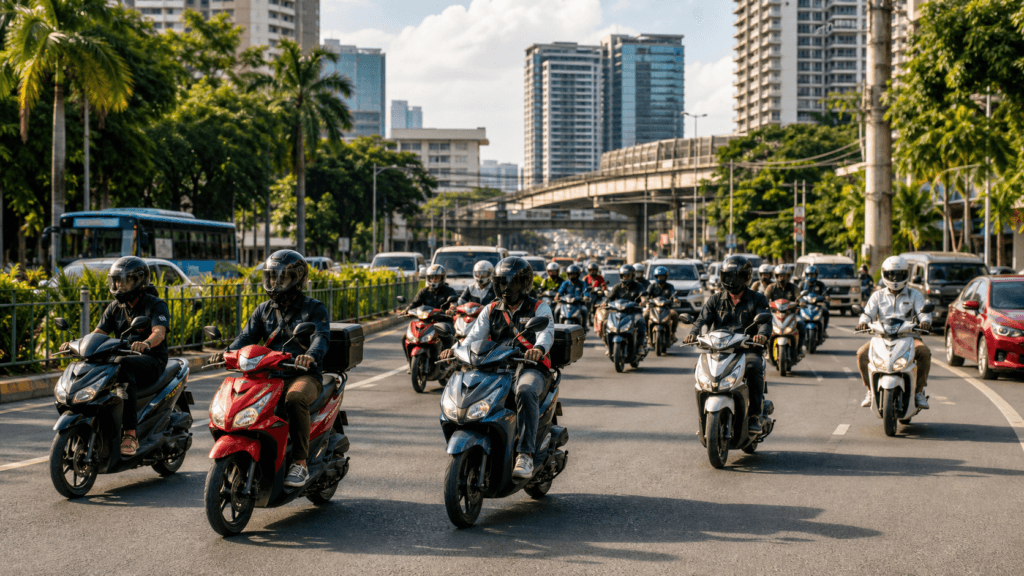
The Philippines is one of the fastest-growing motorcycle markets in the world — 1.87 million motorcycles were sold in 2025 (up 11%), the riding population is roughly 7–8 million, and the accessory market is growing at 5.8% CAGR. What sells best are rider essentials: rain suits, phone holders, LED auxiliary lights, reflective vests and protective gear — categories where Chinese factories already dominate the mid-price range. This guide explains what is hot in the Philippines in 2026, who the buyers are, and how importers and distributors can source profitably.
For suppliers and distributors planning to enter Southeast Asia, the Philippines deserves first priority: it combines huge unit sales, a booming delivery-rider economy, and one of the region’s most active motorcycle modification cultures. Understanding the local market structure is the difference between stocking winners and sitting on dead inventory.
Philippines Motorcycle Market at a Glance
| Indicator | Data |
|---|---|
| 2025 motorcycle sales | 1,870,846 units (+11% YoY, record year) |
| Registered fleet | ~7–8 million motorcycles & tricycles |
| New units added | ~160,000 per month |
| Market leaders | Honda (~55% share), Yamaha (~23%) |
| Accessories market growth | 5.8% CAGR (2025–2031) |
| E-commerce split | Shopee ~55% of GMV, then Lazada, then TikTok Shop |
Sources: Manila Bulletin (Feb 2026), MDPPA, ABS-CBN (Sep 2024), 6Wresearch (2025). The Philippines adds roughly 16,000 new motorcycles every month — every one of them a potential customer for accessories, protection gear and rider essentials.
What Sells in the Philippines: Top Categories with Price Evidence
Retail price evidence below is drawn from Shopee PH and Lazada PH listings (August 2026). Three of the top four categories are exactly what a Chinese factory already produces — which is why a factory-direct supplier has a natural cost advantage.
| Category | Retail price band (PHP) | ≈ USD | Demand signal |
|---|---|---|---|
| Rain suits / raincoats | ₱158 – ₱4,490 | $3 – $75 | Lazada singles with 3.3K+ sold; monsoon season (Jun–Nov) staple |
| Phone holders / waterproof phone bags | ₱85 – ₱8,500 | $1.5 – $140 | Delivery riders buy one each; ₱100–800 is the volume zone |
| LED auxiliary / MDL lights | ₱66 – ₱1,500 | $1 – $25 | High SKU density; modification culture is strong |
| Knee guards / armor | ₱269 – ₱5,095 | $4.5 – $85 | Fastest-growing protective gear segment (6Wresearch) |
| Riding gloves | ₱85 – ₱2,500 | $1.5 – $42 | Daily commuters + riders; ₱200–600 volume zone |
| Reflective vests | ₱150 – ₱600 | $2.5 – $10 | Night rider compliance; pairs with rainwear |
| Waist / leg bags | ₱200 – ₱1,000 | $3 – $17 | Rider EDC storage; part of the “rider three-piece” with phone holder + raincoat |
| Saddle bags / tail bags / side bags | ₱595 – ₱9,500 | $10 – $160 | Commuting cargo staple; higher ticket item |
The pattern is clear: the volume winners are affordable rider essentials — rain protection, phone mounting, visibility and basic safety gear. Premium branded gear (Komine, LS2, FIVE) exists but sells in far smaller quantities; the ₱100–1,500 band is where volume lives.
Who Buys in the Philippines: Buyers and Channels
- Delivery riders (Grab, Lalamove, foodpanda, Move It, Angkas): constant buyers of rainwear, phone holders, reflective vests and leg bags — a professional consumables segment with repeat purchases.
- E-commerce sellers on Shopee/Lazada/TikTok Shop: the fastest-growing distribution channel; many cross-border sellers ship directly from China.
- Wholesale markets: Divisoria and Binondo in Manila are the country’s motorcycle accessories wholesale hubs — a single trip reaches hundreds of resellers.
- Retail chains: Motoworld, Casco Market (13 stores) and specialty shops carry mid-to-premium brands.
- Importers/distributors: companies like Yohingco Trading import branded lines and distribute to retailers and online sellers.
China is already one of the top source countries for Philippine motorcycle accessories (alongside Indonesia, Thailand, Vietnam and India), and imports grew 7.47% in 2024 — the import-driven structure is well established.
Import Requirements: Certification, Duties and Logistics
- Helmets are the main regulated category: motorcycle helmets and face shields require BPS certification (PS for local manufacture, ICC for imports) under RA 10054. Accessories such as rainwear, phone holders, gloves, armor and reflective vests have no confirmed mandatory certification — but verify the exact HS code with DTI-BPS or a local forwarder before shipping, especially for electrical items like LED lights.
- Duties: imports pay 12% VAT on the duty-paid value, plus the applicable AHTN tariff for HS 8714 parts. China-Philippines trade under RCEP allows preferential tariffs with a Form E certificate of origin — claim it on every shipment to stay competitive against ASEAN-origin suppliers.
- Logistics: cross-border e-commerce parcels (7–15 days from China) are mature for testing; volume wholesale moves by LCL/FCL sea freight to Manila with local clearance and warehousing.
How to Source: What Philippine Buyers Expect from a Factory
- Low MOQ: Filipino importers and Shopee sellers typically start with small trial orders. A factory that accepts MOQs from 10–50 pieces and supports mixed-model orders wins the first order.
- OEM/ODM branding: local resellers want their own brand and packaging; private label with custom logo and size-grade labels is the standard request.
- Fast samples and 24-hour quoting: speed to quote decides who gets the trial order.
- Rainy-season readiness: stocking rainwear and waterproof gear before June–November matters; distributors order ahead of the monsoon.
MOTORCM (Foshan Cangmang Technology) is a factory-direct supplier covering exactly these categories — rain suits, phone holders, LED auxiliary lights, reflective vests, protective gear and motorcycle bags — with OEM/ODM, low MOQ and RCEP-compliant export documentation.
FAQ
1. What motorcycle accessories sell best in the Philippines?
Rain suits, phone holders, LED auxiliary lights, reflective vests and basic protective gear (knee/elbow pads, armor) are the volume sellers. They serve the large delivery-rider population and monsoon-season needs, with most sales in the ₱100–1,500 retail band.
2. Is there a big market for motorcycle accessories in the Philippines?
Yes. The Philippines sold 1.87 million motorcycles in 2025 (+11%), has an estimated 7–8 million registered motorcycles, and its accessories market is growing at 5.8% CAGR. Around 160,000 new motorcycles are added every month.
3. Do I need certification to import motorcycle accessories to the Philippines?
Helmets and face shields require BPS certification (PS/ICC). Most accessories such as rainwear, gloves, phone holders and armor have no confirmed mandatory certification, but you should verify the exact HS code with DTI-BPS or a licensed forwarder before shipping, especially for electrical products like LED lights.
4. How much import duty do motorcycle accessories pay in the Philippines?
Imports pay 12% VAT on the duty-paid value plus the applicable AHTN tariff for the HS 8714 chapter. Under RCEP, Chinese-origin goods can claim preferential tariffs with a Form E certificate of origin.
5. Where do Philippine wholesalers buy motorcycle accessories?
Divisoria and Binondo in Manila are the main wholesale hubs. Many importers and distributors (such as Yohingco Trading) source directly from Chinese factories, and Shopee/Lazada sellers often buy from factories with low MOQ and OEM branding support.
6. Does MOTORCM ship to the Philippines?
Yes. MOTORCM ships worldwide, including the Philippines, with both cross-border e-commerce parcels and sea freight (LCL/FCL) to Manila, and provides RCEP Form E documentation to help buyers save on duties. Request a wholesale quote for pricing, MOQ and lead times.
Conclusion
The Philippines offers the strongest near-term opportunity for motorcycle accessories suppliers: record motorcycle sales, a massive rider population, an active modification culture and a delivery-economy that keeps buying essentials. For factories that already make rainwear, phone holders, lights and protective gear — the exact categories that sell — entering with low-MOQ, OEM-friendly terms and RCEP documentation is the fastest route to volume.
Ready to supply the Philippine market? Contact MOTORCM for a wholesale quote — low MOQs, OEM/ODM support and RCEP-optimized export documentation.