
How to Choose Motorcycle Auxiliary Lights for Southeast Asia Distributors
Who this guide is for — and who it is not for
This guide is written for distributors, wholesalers and motorcycle brands in Southeast Asia who buy auxiliary lights in bulk and resell them to dealers or riders. If you buy 50 pieces at a time or more, if you need your own logo and packaging, or if you are choosing a factory to work with for more than one order, this guide is for you.
It is not a rider’s buying guide. It does not tell an individual rider which single light to put on one bike. If you are a rider buying one set, the product pages and the wiring guide will help you more than this article.
It is also not for you if you only need the lowest price for one order and you do not care whether the second order matches the first. This guide spends a lot of time on consistency, because for a distributor, a second order that does not match the first is more expensive than a slightly higher first price.
Start from the use case, not from the wattage
Most buyers start by asking “how many watts?” That is the wrong first question. Two lights can both be called 100W and behave very differently on the road, because wattage alone does not tell you the beam pattern, the colour temperature, the voltage range, or whether the light survives rain and vibration.
Start from where your customers actually ride:
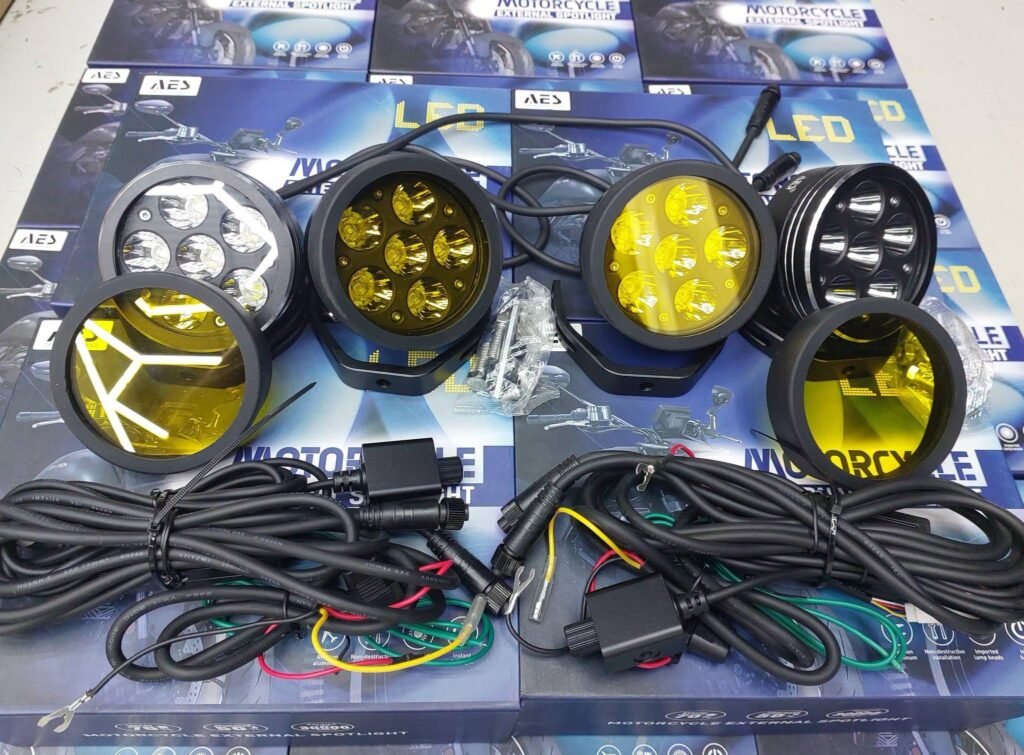
- Night riding and touring. The rider needs to see further ahead on dark roads, and to be seen by other traffic. A dual-colour light helps here, because the rider can switch colour for different conditions. Our 3.9-inch dual-colour fog light is built for this use: 100W, 12–80V, IP68, CE and RoHS listed on the product page.
- Off-road and adventure riding. The light will be shaken, splashed and sometimes dropped. Waterproofing and the bracket matter more than a small difference in wattage. Ask how the bracket is fixed, and whether the dealer can replace it separately.
- Delivery and commuting in the city. The rider is on the bike for hours, often in rain, often at low speed in traffic. The light must not drain the battery at idle, must not blind oncoming traffic, and must survive daily rain. This is the Philippines commuter and delivery market in particular — see the separate guide linked below.
- Long-distance touring. The rider needs a light that can run for hours without overheating and without flickering when the voltage changes. Voltage range matters here more than peak wattage.
If you cannot describe your customers’ riding in one of those four lines, stop and ask your dealers first. A distributor who buys the wrong use case will have stock that does not move, even if the price was good.
100W vs 110W: two different models, not two versions of the same light
This is a point buyers often get wrong, so we state it plainly.
The 100W dual-colour fog light (3.9-inch) and the 110W strobe fog light are two separate models. Do not treat the 110W as an upgraded version of the 100W, and do not compare them only by the number.
- 100W dual-colour, 3.9-inch — /product/dual-color-motorcycle-fog-light-3-9-inch/ — 100W, 12–80V, IP68, CE and RoHS, dual-colour output, sample lead time 5–7 days. Suitable for night riding, off-road, touring and long-distance use. Listed fitment on the product page includes Yamaha NMAX 155, Aerox, Honda ADV 160, PCX 160, Click 125/150, CB500X and BMW R1250GS/ADV. If a model is not listed, ask us to confirm fitment before ordering — do not assume it fits.
- 110W strobe — /product/motorcycle-fog-light-110w-strobe/ — 110W, 12–80V, IP68, sample lead time 5–7 days. A separate model with a strobe function. Suitable where a strobe function is wanted and allowed in the target market. Before ordering, confirm with us whether strobe use is permitted for your market and use case, because rules differ by country and by road use.
If a supplier tells you the two numbers are interchangeable, or that one light is “100W/110W/120W” at the same time, treat that as a warning sign. A factory that cannot keep its own wattage straight on one model will not keep sample and bulk consistent either.
Voltage: 12–80V, and why the range matters
Both models above work on 12–80V DC. That range matters in Southeast Asia because the same light may be fitted to a small commuter bike, a larger touring bike, or a bike with a different charging system.
What to check before you order:
- What voltage does your main selling model run at — 12V only, or a wider range?
- Does the light flicker or dim at idle? Ask for the answer in writing, not just “no problem”.
- Does the dealer need an extra relay or harness, or is the standard harness enough? The product page lists bracket and harness requirements — if your market needs a different bracket, say so before ordering, not after the goods arrive.
If you do not know your customers’ voltage, ask three of your dealers. Do not guess. A light that works on a bench test at 12V and fails on a bike at a different voltage is a returns problem, not a product problem.
IP68 vs IP67: what the number does and does not promise
Our fog lights are IP68. The existing guide /ip67-vs-ip68-auxiliary-light/ explains the difference in detail, so we will not repeat the full table here.
The short version for a distributor: IP68 means the light is rated for dust and for water immersion under the test conditions for that rating. It does not mean the light cannot fail if the seal is damaged during installation, if the bracket cracks the housing, or if the wiring entry is left open.
When you compare suppliers, ask three questions:
- Is the IP rating tested on the finished light, or only on a component?
- What happens to the warranty if the dealer opens the housing to change a bracket?
- How do you handle a water-ingress claim — do you need a photo, the light back, or a test report?
If a supplier cannot answer those three questions, the IP number on the page is not enough to base a bulk order on.
What a distributor must provide before ordering
A bulk order goes wrong most often before production starts, not during production. The factory cannot guess your logo, your packaging, your bracket, or your market rules. Provide these before you ask for a final quote, and the quote will be faster and more accurate:
- Logo file. Vector file if you have it. If you only have a JPG, say so — the factory will tell you whether it can be used for laser marking or printing, or whether it needs to be redrawn.
- Packaging requirements. Retail box, plain box, or your own box design? Does the box need a barcode, a warning label, or a local-language label?
- Bracket and harness. Which bike models are you selling to? Do you need a specific bracket, a longer harness, or a different connector?
- Target market and quantity. Which country, how many pieces, in-stock or custom OEM? In-stock MOQ is 50 pcs. Custom OEM MOQ is 500+ pcs. If you need a custom colour, logo, or packaging, you are in the custom OEM range — say so at the start.
- Certification needs. Which certificates does your market require? The product pages list CE and RoHS for the 100W model. If your market needs a specific certificate or a certificate number, ask for it before ordering and confirm what document you will receive. Do not assume a CE mark on a page is the same as a certificate for your market. See /ce-ece-dot-certifications-explained/ for the difference between CE, ECE and DOT.
If you do not have a full drawing yet, you can still start. Say “no full drawing yet, here is the bike model, the bracket photo, and the quantity”. A factory that can work with that and tell you what else it needs is a better partner than a factory that asks for a full drawing and then goes quiet.
Our quote response time is within 24 hours. If your enquiry does not include the five items above, the first reply will be a list of questions, not a price. That is normal — it is faster than a wrong price.
Sample vs bulk: how to check consistency before you commit
For a distributor, the sample is not a souvenir. It is the reference for the bulk order. Use it that way:
- Test the sample the way your customer will use it. Fit it to the actual bike model, run it in rain if possible, check it at idle and at speed, and check the bracket after a ride.
- Photograph the sample. Front, back, bracket, harness, connector, packaging, and any marking. Keep those photos. When the bulk order arrives, compare the same six points.
- Ask what is fixed and what can change. Which parts of the sample are the standard specification, and which parts were made only for the sample? If the factory changes the LED, the lens, or the bracket between sample and bulk without telling you, you will find out from your dealers, not from the factory.
- Agree the check before production. Ask: what will you check before shipment, and what photos or test results will you send? If the answer is “we will check”, ask what “check” means in practice.
Sample lead time for the fog lights above is 5–7 days. Sample fee and refund terms are not listed on the product page — ask us to confirm them in writing before you pay for a sample.
>
What we do not do
A distributor should also know what a factory will not do, before the order:
- We do not promise a wattage, a lumen figure, or a beam distance that is not on the product page. If a number is not listed, ask us — do not take a number from another supplier’s page and assume it applies to our light.
- We do not guarantee that a light fits a bike model that is not listed on the product page. Ask us to confirm fitment first.
- We do not change the specification between sample and bulk without telling you. If a component has to change, we will tell you before production, not after shipment.
If a supplier promises all three of those without any qualification, be careful. A real factory has limits, and a factory that hides its limits will hide its problems too.
Deep FAQ: the questions buyers are embarrassed to ask
I do not have a full drawing yet. Can I still get a quote?
Yes. Send the bike model, a photo of the bracket or mounting point, the quantity, and the target market. We will tell you what else we need. A quote without a drawing will be an estimate until the bracket and logo are confirmed — that is better than a fixed price based on a guess.
I already have a supplier. I just want an alternative. How do I start?
Start with one model, not your whole range. Send us the model you sell most, the quantity you buy per order, and the problem with your current supplier — price, quality, delivery, or communication. We will tell you whether we can match the specification, and what would change if you switch. See the separate guide on switching suppliers.
I am worried the bulk order will not match the sample. How do you control that?
Ask for the pre-shipment check list and the photos that will be sent before shipment. Compare the bulk goods against the sample photos you kept — bracket, harness, connector, marking, packaging. If a component has to change, we will tell you before production. If a supplier will not put that in writing, do not place a bulk order.
Can you provide certification documents for my market?
The 100W model lists CE and RoHS. For other certificates, or for a certificate number for a specific market, ask before ordering and confirm which document you will receive and when. Do not order first and ask for the document after the goods are shipped.
What if my dealers install the light wrongly?
That is the most common cause of a “faulty” light. The wiring guide /12v-motorcycle-auxiliary-light-wiring-guide/ covers the basics. The distributor guide on wiring (S3 in this cluster) covers what to tell dealers before installation — relay, fuse, battery drain at idle, and waterproofing the wiring entry. Send that guide to your dealers with the first order.
How long does a quote take?
Within 24 hours, if your enquiry includes the five items listed above: logo, packaging, bracket/harness, target market and quantity, and certification needs. If it does not, the first reply will be questions.
What to do next — different steps for different stages
- Still comparing: read the comparison article S1 (100W vs 110W) and the IP67 vs IP68 guide. Do not order yet.
- You know the use case but not the model: read the Philippines commuter and delivery guide S2, then check the two product pages linked above.
- Ready to ask for a price: send the five items listed above through the Get Quote page /get-quote/ or WhatsApp. You will get a reply within 24 hours.
- Ready to verify the factory: read the factory verification guide S4 before your first bulk order.
A website that only gives you a “Contact Us” button is not helping you decide. The steps above are the point of this guide: each one moves you one step closer to an order you will not regret.