
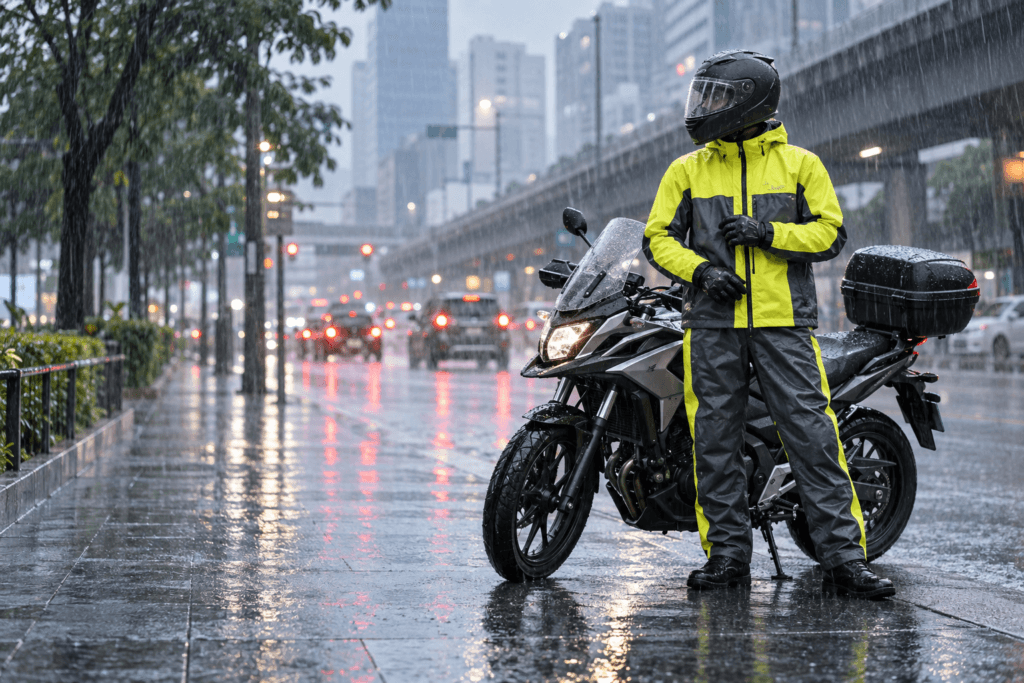
Short answer: Effective motorcycle rain gear must keep water out at the seams, closures, crotch, cuffs and boot overlap while remaining quick to put on, visible in poor weather and comfortable enough for daily commuting. For wholesalers and private-label brands, the best rain suit is not simply the product with the highest waterproof number—it is the product that still works after repeated riding, packing, washing and real-world movement.
Recent rider discussions show why this matters. A highly active September 2026 r/motorcycles conversation about enjoying rain riding drew hundreds of votes and repeatedly mentioned proper weather protection. In a recent MotoUK discussion about rainproof commuting gear, riders compared laminated garments with inexpensive over-suits, while a commuting-gear discussion raised recurring complaints about water entering around the crotch and boots. These are individual rider opinions rather than laboratory test results, but they reveal the practical failure points buyers notice first.
Key takeaways for motorcycle rain gear buyers
- Waterproofing is a system: fabric, seam sealing, zippers, storm flaps and garment overlaps must work together.
- Coverage matters: test the suit in a seated riding posture, especially the lower back, crotch, cuffs, collar and boot openings.
- Fast on and off wins commuters: oversized openings and simple closures reduce roadside frustration.
- Visibility must work in rain: use reflective material and high-visibility panels where they remain visible on the motorcycle.
- Breathability needs honest positioning: a light over-suit and a laminated riding garment solve different problems.
- Wholesale specifications must be measurable: define test methods, size tolerances, seam construction, packaging and inspection criteria before production.
What is motorcycle rain gear?
Motorcycle rain gear is protective outerwear designed to reduce water penetration and wind exposure while a rider is on a motorcycle. It commonly includes a one-piece or two-piece over-suit worn over normal riding gear, or a waterproof motorcycle jacket and trousers with an integrated membrane.
An over-suit is usually lightweight, packable and relatively easy for retailers to sell as an add-on. A laminated or membrane-equipped garment can offer better daily convenience and less water absorption, but it normally costs more and requires more complex construction. Neither option is automatically best. The right product depends on ride duration, climate, customer budget, storage space and whether the garment must also provide impact and abrasion protection.
Seven specifications commuters care about most
1. Waterproof construction, not only a fabric claim
A fabric can test as waterproof while the finished garment still leaks. Needle holes, unsealed seams, zipper ends, pocket openings and panel junctions are common entry points. Ask suppliers to state the fabric test method and result, but also define how seams are sealed and how closures are protected.
For sample approval, inspect seam tape width and adhesion, especially around curves. Check whether storm flaps direct water away from the main zipper. Fill pockets with dry paper and expose the garment to controlled spray. A complete garment rain test is more useful than relying on a material certificate alone.
2. Crotch and seat design
Riders frequently complain that waterproof trousers fail around the crotch or seat. These areas experience pooling water, pressure and repeated flexing. Too many intersecting seams can increase risk, while a short rise can pull panels tight in the riding position.
Test trousers on a rider seated on a motorcycle or realistic fixture. Inspect the crotch seam layout, seat reinforcement and tape continuity. The waist must stay high enough to overlap the jacket even when the rider leans forward.
3. Collar, cuff and boot overlap
Water often enters from garment openings rather than through the main fabric. A collar should seal comfortably without directing rain down the neck. Sleeves must overlap gloves in the intended wearing configuration, and trouser hems must cover boots without riding up.
Specify adjustable cuffs, a soft collar lining, sufficient sleeve and leg length, and a secure hem opening. Test these features while the rider wears normal motorcycle gloves and boots. Wider lower-leg openings can make the trousers faster to put on, but they still need a reliable closure against wind-driven rain.
4. Quick roadside use
Commuters may need to put on rain gear beside the road with limited shelter. Small zippers, narrow ankle openings and complicated layers make a product less useful even if it is waterproof.
Ask sample testers to put the suit on over a jacket, trousers and boots. Time the process, operate every closure with wet gloves and check whether the material catches on armor or footwear. A two-piece design offers flexibility; a one-piece design can reduce waist leakage but may take longer to enter. Product positioning should state this trade-off clearly.
5. Visibility in poor weather
Rain reduces contrast and can obscure vehicles. High-visibility color blocks and retroreflective panels can help a rider stand out, although they do not replace lights, responsible riding or local safety requirements.
Evaluate reflective placement from the front, sides and rear with the rider seated and wearing a backpack. Confirm adhesion or stitching, wash durability and performance after repeated folding. Visibility elements should not be hidden under the arms or covered by common luggage.
6. Ventilation and condensation control
No rain garment can be evaluated only from the outside. Riders may feel wet because of sweat and condensation even when rain has not penetrated. Breathable membranes can help, but performance changes with temperature, humidity, activity and garment layers.
For hot and humid markets, consider lightweight fabrics, protected vents and a loose-enough cut that allows airflow over riding apparel. Avoid absolute “breathable” promises without a defined test method. Explain whether a product is intended for short urban showers, long-distance rain or year-round use.
7. Packability and durability
Rain gear that is too bulky may be left at home. At the same time, extremely thin fabric can tear around foot openings, fasteners or luggage contact points. Buyers should specify packed dimensions, weight and storage-bag construction alongside tear strength and abrasion considerations.
Inspect the garment after repeated folding, packing and unpacking. Test zipper sliders, snaps, hook-and-loop fasteners, elastic and coatings after care cycles. A repairable storage bag and replaceable components can improve perceived value.
Over-suit or waterproof riding suit?
| Product type | Best use | Advantages | Buyer considerations |
|---|---|---|---|
| Lightweight two-piece over-suit | Urban commuting and occasional showers | Affordable, packable, flexible sizing | Waist overlap, entry speed, hem security and condensation |
| One-piece rain over-suit | Longer rides in persistent rain | Fewer waist gaps, continuous coverage | Entry difficulty, toilet access, storage size and fit over armor |
| Membrane-lined jacket and trousers | Mixed-weather touring | Integrated weather layer, familiar fit | Liner bulk, drying time, ventilation and construction complexity |
| Laminated waterproof riding gear | Frequent all-weather commuting | Outer fabric absorbs less water, convenient daily use | Higher cost, technical manufacturing and market positioning |
Wholesale sourcing specification
| Area | Define before requesting a quotation |
|---|---|
| Target user | Urban commuter, delivery rider, touring rider or mixed use |
| Rain exposure | Short showers, one-hour commute or all-day touring |
| Product format | One-piece, two-piece, fixed membrane, removable liner or laminated shell |
| Fabric | Fiber content, coating or membrane, weight and color |
| Waterproof test | Test method, minimum result and finished-garment rain test |
| Seams | Seam type, seam-tape specification and inspection standard |
| Openings | Collar, cuff, waist, zipper flap and boot-overlap design |
| Visibility | High-visibility areas, reflective placement and durability |
| Sizing | Garment measurements over riding gear and target-market size ratio |
| Branding | Logo method, labels, hangtags, storage bag and packaging |
| Order | Sample quantity, MOQ per color/size, lead time and reorder plan |
Sample approval checklist
- Compare the sample with the signed technical specification.
- Confirm garment and packed measurements, weight and size tolerances.
- Put the suit on over real riding gear and boots.
- Check coverage in an upright and forward-lean riding position.
- Spray-test seams, zipper ends, pockets, crotch, seat and openings.
- Operate all closures while wearing wet motorcycle gloves.
- Inspect reflective visibility from the front, sides and rear at night.
- Repeat folding and storage cycles, then recheck coatings and seam tape.
- Verify labels, care instructions, model code and packaging claims.
- Approve and retain a sealed reference sample before bulk production.
Frequently asked questions
What waterproof rating is good for motorcycle rain gear?
There is no single number that proves a finished suit will stay dry. Buyers should compare the stated material test method and result, then evaluate seams, closures, overlaps, riding-position coverage and a finished-garment rain test. The appropriate requirement depends on expected rain duration and market positioning.
Is a one-piece or two-piece rain suit better?
A one-piece suit can reduce gaps around the waist, while a two-piece suit is usually easier to put on, remove and use separately. For commuters, entry speed and storage may favor two pieces. For prolonged rain, continuous one-piece coverage may be attractive. Test both with the target rider and riding gear.
Why do waterproof motorcycle trousers leak at the crotch?
Water can pool under the rider while pressure, movement and intersecting seams stress the construction. Insufficient seam sealing, poor panel design or a rise that becomes tight in the riding position can contribute. Sample testing must include a seated motorcycle posture.
Should rain gear fit over motorcycle armor?
An over-suit should be sized and patterned to fit over the intended jacket, protectors and trousers without restricting movement. Do not simply add one generic size. Establish finished garment measurements and test the full size range over representative riding gear.
Can MOTORCM customize motorcycle rain gear?
Yes. MOTORCM is a motorcycle accessories and riding gear manufacturer and trading company in Foshan, China. We support OEM/ODM development, private labels, custom colors, reflective layouts, packaging and wholesale supply. Available materials, test documentation, MOQ and lead time depend on the selected construction and order requirements.
Turn rider complaints into a better product brief
The clearest lesson from current rider discussions is that rain gear fails at details: a wet crotch, water entering a boot, a collar that channels rain, or a suit that takes too long to put on. A strong wholesale brief converts those complaints into measurable construction and sample tests.
Explore MOTORCM’s motorcycle rain gear range, review our motorcycle gear sizing guide and learn about our OEM/ODM capabilities. For a relevant quotation, send the destination market, product format, required features, size range, branding needs and estimated quantity through our wholesale inquiry form.
Editorial note: Reddit discussions are cited as qualitative market feedback. They do not constitute product testing, legal guidance or proof that a garment prevents injury.