
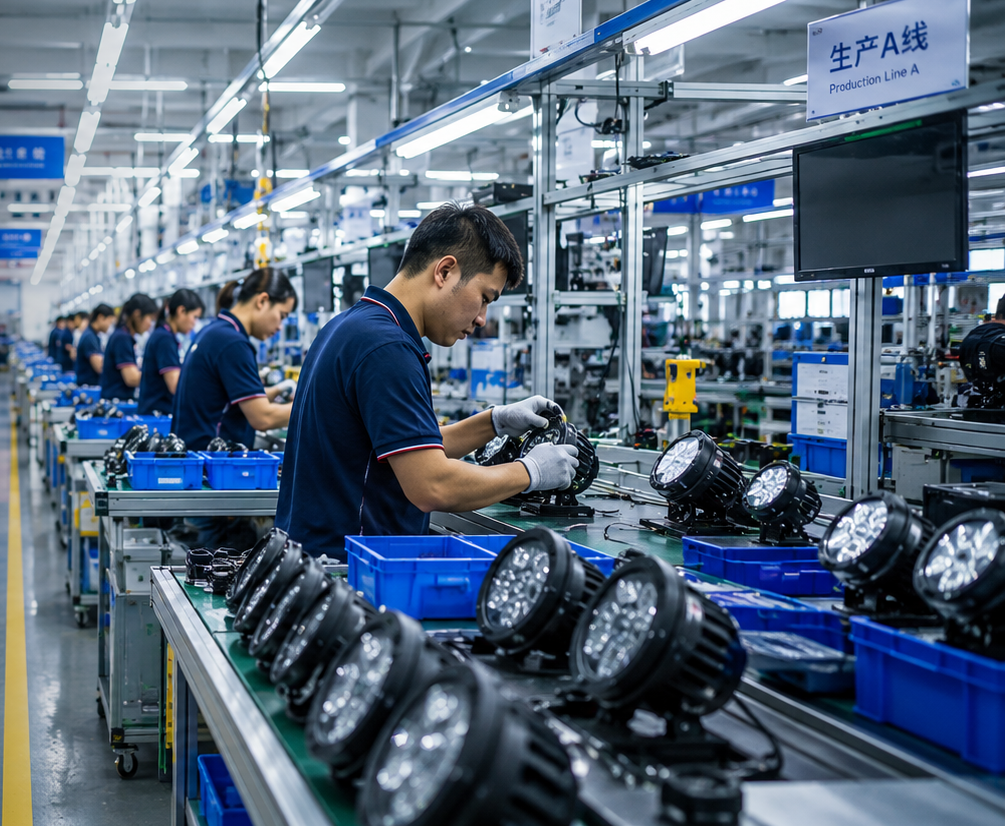
OEM (Original Equipment Manufacturer) means the buyer provides the design and owns the intellectual property while the factory only produces; ODM (Original Design Manufacturer) means the factory supplies an existing design that the buyer rebrands, with the factory retaining IP on the core design. Choose ODM when you are a new brand needing low MOQs and fast market entry; choose OEM when differentiation or exclusivity is your competitive edge. In motorcycle gear sourcing from Foshan, China, a hybrid strategy — ODM for standard items like lighting, OEM for proprietary designs — is the most cost-effective approach for distributors.
1. Defining the OEM vs ODM Difference: Blueprints vs. White Labels
The fundamental distinction between OEM and ODM lies in who provides the design and who owns the technical specifications.
What is OEM (Original Equipment Manufacturer)?
In the OEM model, the distributor (you) provides the factory with a complete set of blueprints, technical drawings, and material requirements. The factory acts strictly as the production arm. In the motorcycle industry, this typically involves proprietary technology or unique aesthetic designs that you want to keep exclusive to your brand. You own the IP, but you also bear the costs of research, development, and tooling.
What is ODM (Original Design Manufacturer)?
In contrast, an ODM factory offers pre-existing designs that they have already researched, tested, and manufactured. As a distributor, you select a product from their catalog and customize it with your branding—a process often referred to as “private labeling.” This is the fastest route to creating private label motorcycle gear without the heavy investment of designing products from scratch. The factory usually retains the IP for the core design, while you own the trademark on the branding.
2. Strategic Fit: Which Model Suits Your Business Goals?
Choosing between these two depends on your brand’s maturity and your specific market niche.
- For New Brands & E-commerce Sellers: ODM is almost always the winner. It allows you to leverage the factory’s existing expertise. If you are looking for a low MOQ supplier to test the market, ODM models often have lower barriers to entry because the molds are already built and the production lines are optimized.
- For Established Brands & Innovators: OEM is the path for differentiation. If your value proposition relies on a specific patented feature—such as a revolutionary aerodynamic wing for a motorcycle tail—OEM ensures that no other brand can sell your exact product.
- For Niche Distributors: Hybrid models are common. For example, at MOTORCM, many distributors choose ODM for standard lighting components to save costs but opt for OEM for high-end specialized mounts to maintain a competitive edge.
3. The Step-by-Step Sourcing Workflow: From Inquiry to Warehouse
Navigating the manufacturing process requires a disciplined approach to ensure quality and timing. Here is the typical roadmap:
- Inquiry & 24-Hour Quote: Start by sending your requirements. Professional factories in the motorcycle gear sector, like those in Foshan, typically provide a quote within 24 hours once specifications are clear.
- Sampling (5-7 Days): Before mass production, a sample is non-negotiable. Whether it is a logo-printed auxiliary light or a custom-stitched glove, expect a sampling turnaround of 5 to 7 days.
- Prototype Confirmation: Evaluate the sample for material quality, finish, and functionality. This is the stage to catch errors before they become expensive mistakes.
- Mass Production: Once the deposit is paid and the sample is signed off, the factory begins the bulk run.
- Quality Control (QC): A robust QC process involves checking raw materials, in-line assembly, and final pre-shipment inspections.
- Logistics & Shipment: Final goods are packed (custom packaging is a key part of ODM/OEM) and shipped via sea, air, or rail.
4. Comparison Table: OEM vs ODM at a Glance
| Feature | OEM (Original Equipment Manufacturer) | ODM (Original Design Manufacturer) |
|---|---|---|
| Design Ownership | Distributor (You) | Manufacturer (Factory) |
| Customization Level | High (Total Control) | Moderate (Logo, Colors, Packaging) |
| Initial Investment | High (Mold & R&D costs) | Low (No tooling costs) |
| Time-to-Market | Long (Months of R&D) | Fast (Weeks) |
| MOQ Requirements | Typically High | Typically Lower (e.g., 50 units for lighting) |
| Risk Factor | Higher (Unproven designs) | Lower (Proven designs) |
| Ideal For | Innovative, established brands | Distributors, new brands, e-commerce |
5. MOQ and Cost Dynamics: Maximizing Margins
Cost structures vary significantly between the two models. OEM projects usually involve “Non-Recurring Engineering” (NRE) fees, which cover the creation of new molds and jigs. Because the factory cannot sell your unique design to other clients, they require higher MOQs to justify the production setup.
ODM is significantly more cost-effective for smaller players. By using existing molds, the factory can offer flexible terms. For instance, in the motorcycle lighting category, you can often find a low MOQ supplier that allows for “mix-and-match” orders of around 50 pieces. This enables distributors to stock a variety of styles without tying up all their capital in a single SKU.
6. How to Write a Sourcing Brief (and 8 Questions for Your Factory)
A clear brief is the best insurance against production delays. Your brief should include:
- Detailed material specs (e.g., 6061 Aluminum, IP67 rating).
- High-resolution logo files (AI or PDF format).
- Packaging dimensions and branding guidelines.
8 Questions to Ask Before Signing a Contract:
- Do you have existing molds for this product (ODM), or will we need to build new ones (OEM)?
- What is your standard lead time for a 24-hour quote and 7-day sampling?
- What certifications (CE, DOT, E-Mark) do your current designs hold?
- Can you support “mixed style” orders within a low MOQ framework?
- Who owns the molds if the partnership ends?
- What is your internal QC protocol for motorcycle electronics or safety gear?
- Can you provide custom-branded packaging and manual translations?
- Do you have experience shipping to my specific region (e.g., Europe, North America)?
7. Cooperation Red Flags: IP and Quality Control
When sourcing motorcycle OEM/ODM services, be wary of factories that:
- Refuse Exclusivity on OEM: If you paid for the mold, you should own the rights to the design.
- Lack Transparent Documentation: A professional factory should provide testing reports and material certifications without hesitation.
- Have No Sample Policy: Never skip the sampling phase. A factory that pushes for immediate mass production is a major red flag.
Conclusion: Starting Your Sourcing Journey
The OEM vs ODM difference ultimately boils down to how much control you need versus how much speed and cost-efficiency you want. For most modern motorcycle gear distributors, a strategic mix of both models is the key to a resilient and profitable product portfolio.
Ready to bring your brand to life? Whether you need a 24-hour quote for a new lighting project or want to see samples of our latest designs in 5-7 days, we are here to help.
FAQ
Q1: Can I switch from ODM to OEM later?
Yes. Many brands start with ODM to test the market with low MOQs and then transition to OEM to develop proprietary features once they have proven demand.
Q2: Is the quality of ODM lower than OEM?
Not necessarily. Many ODM products use the same high-grade materials as OEM products. The quality depends on the factory’s standards, not the manufacturing model.
Q3: Does “Low MOQ” mean the unit price will be much higher?
While smaller orders have a slightly higher per-unit cost than bulk orders of 10,000+ pieces, the reduction in inventory risk and storage costs often makes it more profitable for SMEs.
Q4: How do I protect my brand logo in an ODM agreement?
Ensure your contract specifies that the factory only has the right to apply your trademark to the goods you have ordered and cannot sell those branded goods to third parties.